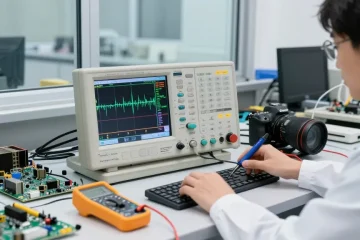
Understanding Benchtop Oscilloscopes for Labs
In the world of electronics, the ability to visualize and analyze electrical signals is crucial for both learning and professional settings. This is where benchtop oscilloscopes come into play, serving as essential tools for engineers, students, and hobbyists alike. These sophisticated instruments allow users to observe waveforms, measure variations in voltage, and troubleshoot electronic circuits effectively. With models designed for precision and versatility, such as those from Hanmatek, professionals can enhance their capabilities and ensure accurate testing and development processes. When exploring options, benchtop oscilloscope for labs provides comprehensive insights into various models suited to specific needs.
What is a Benchtop Oscilloscope?
A benchtop oscilloscope is an electronic test instrument that allows you to observe the changing signal voltages over time. Unlike handheld or portable oscilloscopes, benchtop variants are designed for stationary use, providing larger screens, enhanced features, and greater measurement accuracy. They are often used in labs for educational purposes, R&D, or advanced troubleshooting, making them essential for electronics applications. The basic operation involves plotting voltage signals on a two-dimensional graph, where time is represented on the horizontal axis and voltage on the vertical.
Key Features and Specifications
Benchtop oscilloscopes come packed with features that enhance their functionality. Here are some critical specifications and features to consider when choosing an oscilloscope:
- Bandwidth: The bandwidth determines the highest frequency the oscilloscope can accurately measure. Common options include 110 MHz and 200 MHz, with higher bandwidths suitable for more complex signals.
- Sampling Rate: This is the frequency at which the oscilloscope samples the signal. A higher sampling rate provides better resolution and accuracy, critical for detailed analysis of fast-changing signals.
- Channels: Most benchtop oscilloscopes feature multiple channels (e.g., two, four) to allow simultaneous measurement of multiple signals, which is particularly useful in comparative analysis.
- User Interface: Modern oscilloscopes include intuitive interfaces, often with touchscreens, enabling quick access to settings and features, enhancing the user experience during complex experiments.
- Storage and Connectivity: Many devices now feature built-in memory for data storage and export options, facilitating analysis and reporting.
Applications in Educational and Professional Settings
In educational labs, benchtop oscilloscopes are indispensable tools for teaching fundamental electronics concepts. They allow students to visualize complex waveforms, helping bridge the gap between theoretical knowledge and practical application. In professional settings, engineers and technicians utilize these instruments for circuit testing, signal integrity analysis, and debugging. The precision and flexibility of models like the Hanmatek DOS1104 and DOS1202 enable them to tackle a range of tasks, from basic diagnostics to advanced research and development projects.
Choosing the Right Benchtop Oscilloscope
110MHz vs. 200MHz: Which is Best for You?
Choosing between a 110 MHz and a 200 MHz oscilloscope often depends on the specific applications you intend to pursue. The 110 MHz models, such as the Hanmatek DOS1104, are ideal for general-purpose testing, offering ample bandwidth for most educational and hobbyist applications. Conversely, if your work involves high-frequency signals or complex waveform analysis, investing in a 200 MHz oscilloscope may prove beneficial. This higher bandwidth can accurately capture faster transients and provide greater detail in your measurements.
Evaluating Brands: Why Choose Hanmatek?
When it comes to selecting a benchtop oscilloscope, it’s essential to consider the brand’s reputation, durability, and support services. Hanmatek has established itself as a trusted name in the field, known for manufacturing high-performance oscilloscopes tailored for both professional and educational environments. Their devices often combine advanced features with user-friendly interfaces, making them suitable for a wide array of applications. Additionally, Hanmatek oscilloscopes are designed with built-in safety features and robust construction, ensuring reliability and longevity in rigorous laboratory settings.
Budget Considerations for Lab Equipment
Budgeting for lab equipment can be challenging, especially when high-quality instruments are essential for successful projects. Benchtop oscilloscopes range significantly in price based on specifications and features. It’s crucial to find a balance between cost and functionality. Investing in reliable tools like the Hanmatek series can save money in the long run by reducing the need for repetitive testing and ensuring accurate measurements, thus preventing costly mistakes.
Setting Up Your Lab with a Benchtop Oscilloscope
Essential Accessories and Tools
A well-equipped lab setup enhances the usability and effectiveness of your benchtop oscilloscope. Essential accessories may include:
- Probes: High-quality probes are crucial for accurate signal capture, as they can significantly affect the performance of the oscilloscope.
- Power Supply: Ensure you have a stable power supply that meets the oscilloscope’s requirements to prevent measurement errors.
- Calibration Tools: Regular calibration ensures accuracy over time, making it vital for maintaining measurement integrity.
- Signal Generators: Pairing your oscilloscope with a signal generator allows you to test and troubleshoot circuits effectively.
Best Practices for Calibration and Maintenance
Regular calibration and maintenance of benchtop oscilloscopes are crucial for ensuring long-term accuracy and reliability. Always follow the manufacturer’s guidelines for calibration intervals and procedures. Maintenance tips include:
- Cleaning: Keep the oscilloscope and its components clean to prevent dust and debris from affecting performance.
- Software Updates: Regularly check for firmware and software updates to ensure your oscilloscope has the latest features and bug fixes.
- Prompt Repair: Address any faults or issues immediately to prevent further damage or inaccurate measurements.
Safety Tips in Laboratory Environments
Safety should always be a priority in lab environments. Here are some general safety practices to keep in mind:
- Personal Protective Equipment (PPE): Wear appropriate PPE, including goggles and gloves, especially when working with high-voltage circuits.
- Check Equipment: Regularly inspect probes and cables for wear and damage before use.
- Safe Workspace: Keep your workspace organized and free from hazards to minimize the risk of accidents.
Advanced Techniques for Signal Analysis
Utilizing Multi-Channel Oscilloscope Functions
One of the significant advantages of benchtop oscilloscopes is their ability to measure multiple signals simultaneously. Multi-channel functions allow users to compare different signals and analyze interactions effectively. For example, in troubleshooting a circuit with multiple outputs, using an oscilloscope with four channels can provide insights into how various components interact with one another in real time.
Mathematical Functions for Enhanced Data Interpretation
Many modern oscilloscopes come equipped with built-in mathematical functions that enable users to perform complex calculations directly. These may include operations like addition, subtraction, multiplication, and FFT (Fast Fourier Transform) analysis. By utilizing these features, engineers can extract valuable information from their measurements, such as signal frequency, phase shifts, and overall system performance without the need for external software.
Common Signal Analysis Challenges and Solutions
Signal analysis can often present various challenges, such as noise interference, signal distortion, and inadequate resolution. To address these issues, consider implementing the following strategies:
- Filtering Techniques: Employ built-in filtering options to minimize noise and enhance signal clarity.
- Proper Probe Placement: Ensure probes are connected correctly to reduce the risk of introducing additional noise into the signal.
- Utilize Averaging Features: Use averaging functions to smooth out signal variations over time, providing a clearer picture of the underlying signal trends.
Future Trends in Benchtop Oscilloscope Technology
Upcoming Innovations to Watch in 2026
The oscilloscopes of the future will likely incorporate advanced technologies such as improved user interfaces, greater connectivity options, and enhanced processing capabilities. Innovations may also include larger touchscreens for better visualization and integration with cloud technologies, allowing for real-time data sharing and collaboration among users.
Impact of AI and Machine Learning on Signal Analysis
Artificial intelligence (AI) and machine learning are set to revolutionize the way we analyze signals. These technologies can facilitate predictive maintenance, automate troubleshooting processes, and enhance measurement accuracy by learning from past analysis patterns. Expect to see more oscilloscopes equipped with AI-driven functionalities that assist users in signal interpretation and anomaly detection.
Predictions for the Next Generation of Lab Equipment
Looking ahead, the next generation of lab equipment is expected to be more intuitive, integrated, and adaptable to a variety of testing environments. Features like remote monitoring, advanced data analytics, and collaborative tools will empower users to analyze signals more efficiently and effectively, thereby enhancing research and development outcomes across various industries.
What types of oscilloscopes are best for educational labs?
For educational labs, it’s essential to choose oscilloscopes that are easy to use while offering adequate functionality. Models with touchscreens, visual aids, and beginner-friendly interfaces enable students to grasp complex concepts without overwhelming technicalities.
How to maintain a benchtop oscilloscope effectively?
Regular maintenance involves routine calibration, firmware updates, and cleaning the device to ensure optimal performance. Establish a maintenance schedule and adhere to manufacturer recommendations to prolong your oscilloscope’s lifecycle.
What are the common mistakes when using oscilloscopes?
Common mistakes include improper probe calibration, overlooking safety precautions, and misinterpreting data due to insufficient understanding of the oscilloscope’s features. Training and practice are crucial for effective usage.
Can benchtop oscilloscopes be used for DIY projects?
Absolutely! Benchtop oscilloscopes are valuable tools for DIY electronics enthusiasts, enabling them to analyze and troubleshoot their projects effectively.
What features should I look for in a lab oscilloscope?
Look for features such as adequate bandwidth, multiple channel capabilities, a user-friendly interface, extensive analysis options, and robust data storage capabilities to facilitate effective signal analysis.